News and Insights
From Fragmentation to Friction: What FINN Partners saw 10 years ago
November 24, 2026
Why those pioneering insights lead to client success and better patient care
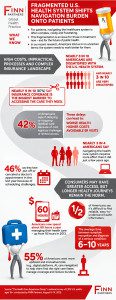
In 2016, FINN Partners asked 1,000 Americans about their experience with the U.S. health system. Almost half had changed health plans in the previous three years. About half of insured respondents had been with their primary care physician for fewer than three years.
What made the survey prophetic was what it revealed about the heavy lift of being a patient, the challenges facing health professionals and the stumbling blocks before health innovators. When coverage changes and relationships turn over, someone still has to remember why a medicine was stopped or what the previous physician wanted to follow up on. We ask people to be the historians of their own care. We ask innovators to address an ever-moving target of ecosystem needs.
“Survey reveals how patients shoulder burden of fragmented healthcare system,” read the headline in Becker’s Hospital Review. O’Dwyer’s PR explored what that turnover meant for keeping a person’s health history together. Years later, the American Academy of Family Physicians cited the survey in discussing how a fragmented insurance market disrupts primary care relationships.
A system that grew over generations
Lower Manhattan’s streets took shape through generations. The Commissioners’ Plan of 1811 gave much of the island’s future growth a shared grid. Those two histories still sit side by side. What interests historians is that a city with an established past could make a deliberate choice about how its next stage of growth would fit together. A past need not dictate a community’s future.
The American health system has grown through generations of decisions, too. Hospitals plan how to deliver care that insurers will reimburse. Insurers decide what they will cover to balance care with cost. Technology companies build for the organizations that buy their products. Each has a job to do, and the decisions they make determine how much work falls to a person seeking care in our “kick-the-can down the road health system.”
 The record was there
During my 97-year-old father-in-law’s final hospital stay, a nurse asked me a question about him. I told her the answer was in his electronic medical record. “I don’t have time to read the EMR,” she replied.
She had 12 new patients. My physician father-in-law had a different nurse almost every two days. I was glad I could answer her question. I wondered what would happen to a person whose family could not be in the room regularly.
This is where fragmentation becomes friction. We can bring information together into a single record and still leave a nurse without a practical way to find what matters at the start of a shift. The information was available. The time and attention required to use it were in short supply.
In Healing the Sick Care System: Why People Matter, I describe a physician spending much of a visit eyes-forward and typing answers into a laptop. At NYU Langone, I checked in on an iPad and a nurse arrived within a minute. The second experience showed me how a digital tool can help someone quickly reach the person they need. A tale of two (medical) cities. The first with its historic winding streets and the other with planned broad boulevards.
Who gets to shape the work?
In the second edition of AI in Health, author Tom Lawry, a former Microsoft executive and now a noted counselor to health systems and professional organizations, sees the potential to “create entirely new ways of working, delivering care and generating value.” The opportunity is to ask what people need from those new ways of working before the workflow has been designed and the concrete has been poured and dried.
“Nurses and nurse informaticists need to be at the forefront of discussions,” Kathleen McGrow, Global Chief Nursing Information Officer at Microsoft, told Johnson & Johnson Nursing. A nurse coming onto a shift can tell a designer what she needs to see first. A family can explain what keeps getting lost in the health-professional handoff.
Those conversations can also shape what we measure in a randomized trial involving 238 outpatient physicians; one of two AI scribes significantly reduced note-writing time compared with usual care. The other showed no statistically significant reduction on that measure. When time is saved, what does the patient experience? Does the physician have a chance to look up and hear the concern the person came in to discuss? Do they have added time to help people with more pressing needs?
Where health and purpose meet
As communicators, we look at how ideas move between communities and how those exchanges shape products, policies and people’s lives. At FINN Partners, that means helping hospital leaders and innovators understand what health professionals know from caring for people every day.
When health professionals have a say in how tools are designed and care is delivered, hospitals can put their resources where they will do the most good. Innovators can create products that fit the realities of care. When the people who use those products see the difference they make, they have a reason to advocate for wider access.
Ten years ago, the FINN survey showed what happens when the health system leaves people to make the connections themselves. A decade later, a person waiting for a breakthrough should be able to ask a health professional who knows them, “Could this help me?” and get an answer they can act on.
That conversation depends on people across the health ecosystem understanding the science, knowing whom it can help, having the time to develop a relationship and working out how to make it available. Helping those people understand one another is how we champion innovations that can sustain and save lives. It is why communication belongs in the work of care from the very beginning.
POSTED BY: Gil Bashe