News and Insights
Is Your Manufacturing Content Ready for AI Search?
August 6, 2026
A GEO guide for manufacturers
In this blog, you will learn:
- Why AI chatbots have become a new front door for industrial buyer research
- How to assess whether your website content is generative engine optimisation (GEO)-ready
- Why blog content created for traditional search engines now falls short
- How to access FINN Partners’ GEO Checklist for Manufacturers.
More and more manufacturing companies are asking us: “How can we make sure our business is visible when prospects search using ChatGPT, Claude or Gemini?”
The answer sounds simple: make your content GEO-ready and cite-worthy.
That means answering the questions your prospects and customers are asking AI platforms, such as generative AI (GenAI) chatbots like ChatGPT, providing credible evidence and reinforcing those answers consistently across earned, owned and paid channels.
The concern, though, is valid. According to GlobalSpec research, 69% of technical buyers use GenAI at different points in their buying journey.
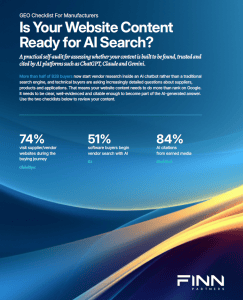
G2’s 2026 survey of more than 1,000 B2B software buyers found that 51% now begin vendor research inside an AI chatbot, rather than a traditional search engine. That figure was 29% a year earlier. The same research found that AI chatbots have become the single biggest influence on which vendors make a shortlist, ahead of review sites, vendor websites and salespeople.
Why has buyer research moved to AI?
For industrial buyers, AI platforms solve a longstanding problem: how to find a clear answer within a large volume of complex technical information.
Procurement engineers, plant managers and factory directors have always researched differently from the general public. While most consumers rarely venture beyond the first page of Google results, more than four in 10 engineers review at least five pages of search results to find the information they need.
Fortunately for them, traditional search is changing.
Google search queries are typically three to four words long. Queries submitted to large language models (LLMs – Gemini, Claude, ChatGPT, etc.) average more than 25 words, allowing buyers to describe the application, problem, technical requirements and desired outcome in much greater detail.
A buyer can now ask a detailed question, add further specifications through a follow-up conversation and receive a summary of the available options. They may even receive an initial shortlist of three or four suppliers before visiting a single vendor website.
This shift matters because B2B buyers spend only 17% of their purchasing time in direct contact with potential vendors, according to Gartner. The remaining 83% of the buyer journey is completed through self-directed research and internal evaluation.
What are technical buyers asking AI?
Technical buyers are not simply searching for product names. They are asking questions linked to operational challenges and business outcomes, such as:
- Which suppliers should we shortlist for a pick-and-place robot?
- How can we reduce factory energy consumption without compromising throughput?
- Which technologies can reduce packaging line changeover times?
- What is the difference between these two competing technical approaches?
- Which solution is best suited to our production environment?
- What regulations or standards should we prepare for?
This helps explain a pattern reported by many manufacturing sales teams.
By the time a prospect speaks to a salesperson, their first questions may concern price, lead time or delivery. It is now more likely than before that the buyer already understands the product specifications, available alternatives and major suppliers in the market.
The research and education stages have not disappeared, though. They have simply taken place before the first sales conversation, increasingly with the help of an AI platform.
Where do AI platforms source their information?
AI visibility is not solely an owned-content challenge.
According to Muck Rack’s latest What Is AI Reading? study, which analysed more than 25 million links included in ChatGPT, Claude and Gemini responses across 17 industries, earned media accounts for 84% of all AI citations.
When someone asks an AI platform about a product, competitor or industry trend, the answer is therefore heavily influenced by credible editorial coverage and other trusted third-party sources. This is the work that effective public relations programmes have always aimed to secure.
The findings are consistent with GlobalSpec research. Online technical publications have doubled in popularity as engineers’ preferred research destinations, with 76% of respondents using them routinely.
Engineers are gravitating towards information that feels editorially independent rather than purely commercially motivated. A company’s presence in trusted third-party publications is therefore not optional. Buyers may already be forming opinions based on this coverage before they reach the company’s website.
However, supplier websites remain important. GlobalSpec found that 74% of respondents visit supplier or vendor websites during the buying journey, often to validate what they have learned elsewhere.
This gives owned content a critical role. Your website must confirm your expertise, support the claims being made about your company and provide the details buyers need to move forward confidently. Read on for more information on how to optimise your content and access FINN Partners’ GEO Checklist for Manufacturers.
What your website is for – and what it is not
Most manufacturers already publish blogs, articles and technical guides. That is a strong foundation.
The problem is that much of this content was created for a different type of reader: a search-engine crawler looking for keywords and a human willing to scroll through several paragraphs before reaching the answer.
The goal of modern content is not simply to generate website traffic.
The goal is to become part of the answer.
AI models aim to answer a specific question at a specific moment. They favour content that:
- Gets to the point within the first few sentences
- Is divided into clearly labelled sections that can be understood independently
- Supports claims with evidence rather than description alone
- Includes original expertise rather than generic commentary
- Is attributed to a named expert rather than an anonymous “marketing team.”
A paragraph that opens with, “In today’s fast-paced manufacturing environment, companies face numerous challenges”, is unlikely to be the passage an AI platform selects when answering a technical buyer.
Having said that, there is no single formatting trick that will make a page consistently citable.
AI visibility depends on a combination of strategy, structure, authority, evidence and tone. It must also be applied across the website rather than added to one isolated blog post.
None of this means writing “for robots”. Directness, useful evidence and logical structure also make content more valuable to a busy engineer, plant manager or procurement lead. That is precisely why AI platforms favour these qualities.
Content that has not been reviewed with this shift in mind may be missing from the conversation at the exact moment a buyer is researching suppliers and forming a shortlist.
Why is consistency so important?
Even well-structured content can damage trust if it conflicts with information found elsewhere.
Buyers may encounter your company through a trade publication, AI-generated summary, product page, salesperson, webinar or distributor. The core facts, terminology and positioning must remain consistent across those touchpoints.
Gartner reports that 69% of B2B buyers experience inconsistencies between information on a sales organisation’s website and information provided by its sellers. When the salesperson’s explanation does not match the company’s wider messaging, it can create mistrust and potentially put the transaction at risk.
The same principle applies to AI visibility. If your website, media coverage and sales materials use conflicting terminology or make different claims, an AI model may struggle to determine which version is authoritative.
GEO-ready content, therefore, cannot be treated as a standalone writing exercise. It requires alignment across the wider communications ecosystem.
Review and optimise content for AI engines regularly
A one-off rewrite can improve an individual article, but it will only take a company so far.
Manufacturers that achieve consistent visibility increasingly treat it as an ongoing discipline. They examine the questions buyers are asking, assess which pages are and are not appearing in AI-generated answers and build a content programme around the most important gaps.
This is different from a conventional search engine optimisation (SEO) audit. It involves reviewing not only keywords and rankings but also:
- The questions associated with priority products, markets and customer challenges
- The authority and clarity of the company’s existing content
- The relationship between earned media coverage and owned website content
- Whether technical expertise is visible and properly attributed
- How consistently the company’s messages appear across channels
- How AI visibility and citations should be monitored over time.
The manufacturers that get ahead will not necessarily be those publishing the most content. They will be the companies producing the clearest, most credible and most useful information at the moment buyer research begins.
FINN Partners helps manufacturing companies assess how their owned and earned content performs across both traditional and AI-assisted search. If you would value input on whether your website is ready for this shift, we would be pleased to discuss where the most valuable opportunities may lie. Contact yulia.tribrat@finnpartners.com to discuss and access the GEO Checklist for Manufacturers.
Frequently Asked Questions
Why does website content still matter if buyers begin their research using AI?
AI platforms may introduce buyers to potential suppliers, but buyers still visit company websites to validate what they have learned. Your owned content needs to confirm your expertise, provide credible technical detail and make it easy for buyers to understand why your solution belongs on their shortlist.
What makes manufacturing content more likely to appear in AI-generated answers?
Content is more likely to be surfaced when it directly answers a real buyer question, uses clear headings, supports claims with credible evidence and includes original insight from a named expert. It should also align with the information buyers encounter through trade media, sales teams and other company channels.
How can manufacturers assess whether their existing content is ready for AI search?
Start by reviewing your strongest blogs, technical articles and product pages against the questions buyers ask. Access FINN Partners’ GEO Checklist for Manufacturers to review your content against. Check whether each page of your content provides a clear answer, includes something worth citing and is consistent with your wider market positioning. This usually reveals the highest-priority gaps before you invest in creating more content.
POSTED BY: Yulia Tribrat